
Wearable Health Data
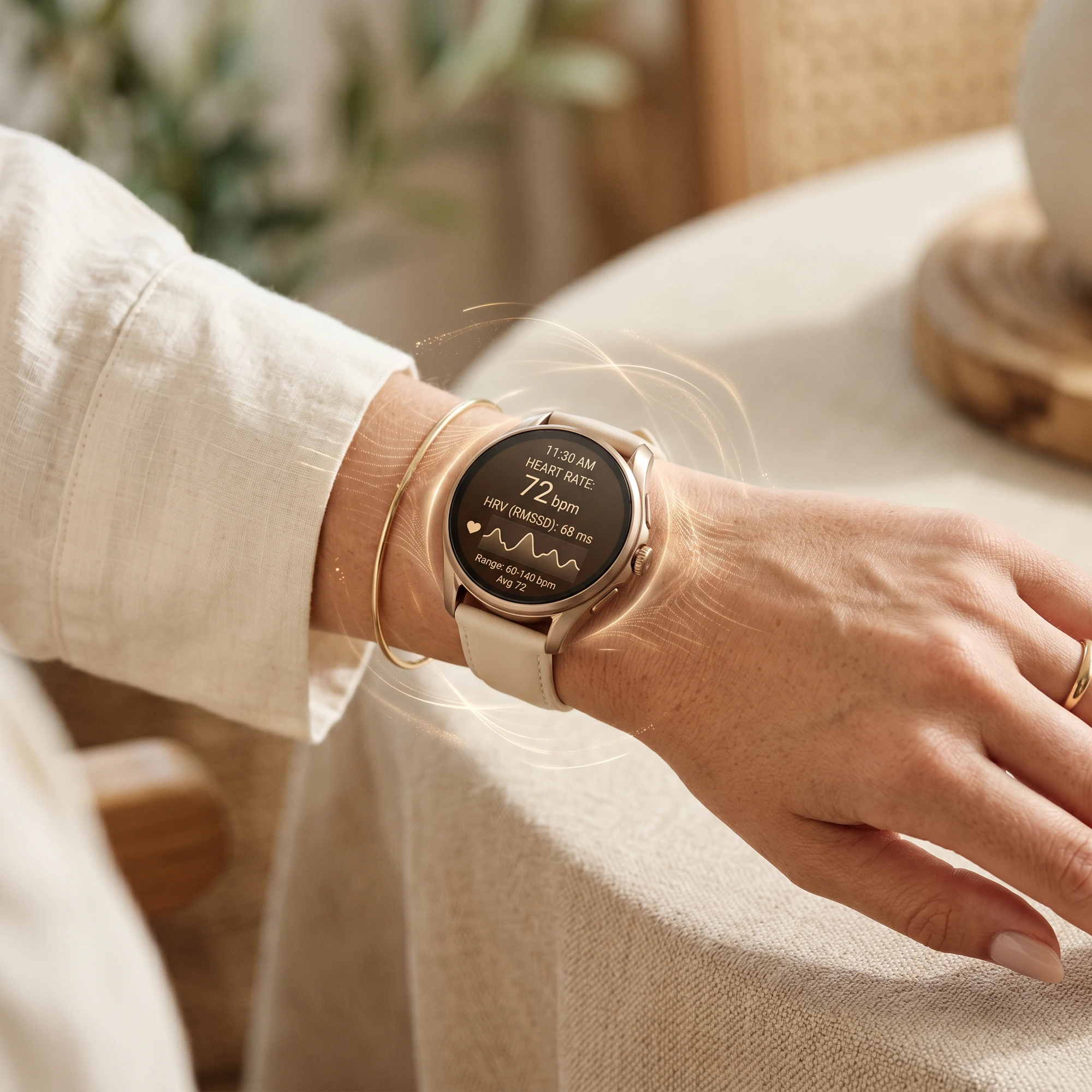
Your wearable already collects thousands of data points a day — heart rate variability, resting heart rate, sleep, respiratory rate, activity load. The problem isn't collection, it's interpretation. At Integrated Wellness, your Oura, Whoop, Apple Watch or Garmin stream flows into your Digital Twin, where it's read against labs and biometrics — turning trends you glance at into decisions your care team acts on.
What do wearables measure well?
Trends. Night-time HRV and resting heart rate are reliable relative signals — your Tuesday versus your baseline — even when absolute values differ between devices. Sleep duration, respiratory rate and activity load are similarly strong as longitudinal trend lines.
Where is wearable data weak?
Absolute precision. Sleep-stage labels (deep vs REM) only moderately agree with lab polysomnography, calorie burn estimates are rough, and single unusual readings are usually noise. That's why we anchor decisions to multi-week trends confirmed against labs — never to one odd night.
Our evidence review of wearables & HRV grades the validation literature device by device.
What is HRV actually telling you?
Heart rate variability reflects the balance of your autonomic nervous system — the interplay of stress and recovery. A suppressed HRV trend often precedes illness, overtraining or accumulating life stress by days. It's your body's earliest broadly-available warning channel.
How does the Digital Twin use wearable streams?
Your wearable trend lines are fused with quarterly labs, body composition and intake context. The Matrix Engine looks for convergence — e.g., falling HRV + rising resting heart rate + worsening sleep efficiency — and flags the pattern for clinical review before you'd have booked an appointment on your own.
Which devices does Integrated Wellness support?
Apple Health, Oura, Whoop, Fitbit and Garmin connect natively. If your device syncs to Apple Health or Google Fit, its data reaches your Digital Twin. There's no proprietary hardware to buy — we meet you on the wrist you already wear.
Medically reviewed by: Dr. Michael Ellis, DO — Medical Director, Integrated Wellness Medical Center
Scientific/technical contribution: John Campetella — Founder & CEO
Last reviewed: June 2026
Which wearable should I buy?
The one you'll wear every day. For sleep and recovery focus, ring form-factors excel; for training, watches with GPS win. The Digital Twin normalizes across brands, so consistency beats brand.
Is my wearable data private?
Streams enter your encrypted clinical record under HIPAA-grade controls and are never sold or shared without your authorization.
Can wearables detect medical conditions?
They surface patterns worth investigating — irregular rhythm notifications, suppressed HRV, rising respiratory rate — but diagnosis always happens with your clinician and confirmatory testing.
How much history do you need?
Two to four weeks establishes a personal baseline. If you've worn a device for years, historical export makes your Digital Twin smarter on day one.
A free, guided assessment — routed to the right clinical or wellness pathway.
Start My Health Assessment